
Can You Mix Different KV and Brand Motors on One FPV Quad?
Every racer hits this sooner or later: you switch to a new motor, crash a few times, and end up with three good motors and a drawer full of something else. Throw the odd ones away, or sell them used for almost nothing?
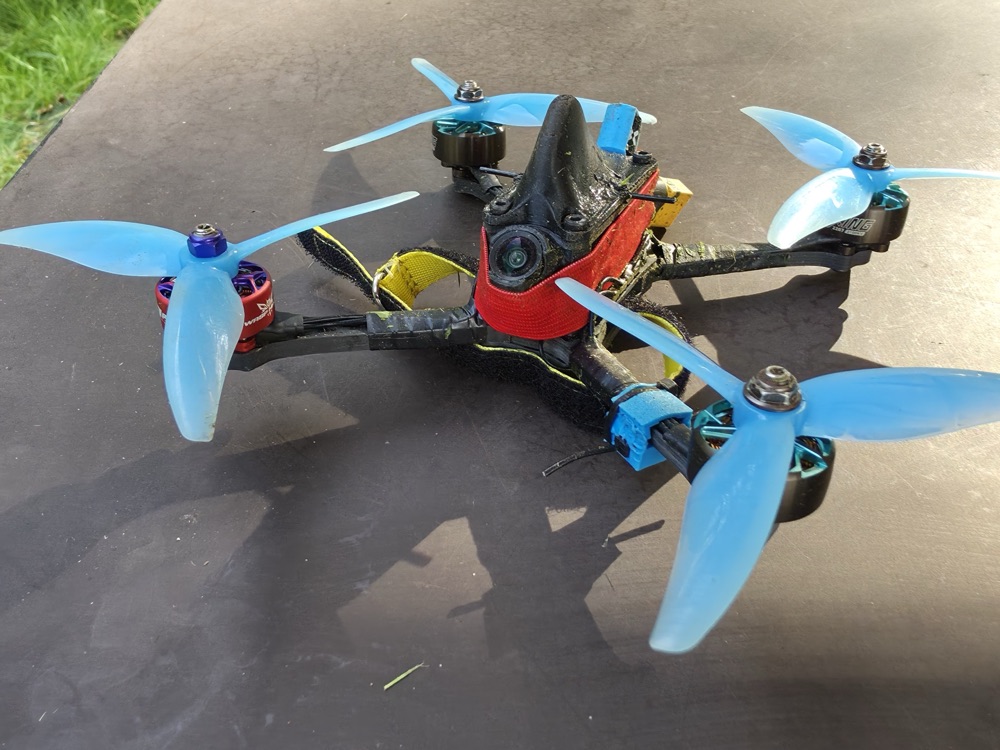
In theory a modern ESC doesn't care what is spinning on the other end of the wires, so mixed motors should just work. I had never tried it on my own quad, so this time I did.
How I Ended Up With Three Motors
I bought five iFlight R5 2100kv motors for a test. One came out of the box with a bent bell, so I was down to four before the first flight. A second one got bent against a race gate, which left me with three matching motors and a choice for the fourth corner:
- Old iFlight R5 2050kv, from my spares. Same R5 line as the new motors, and the closest KV I had.
- RCInPower Wasp Major Evo Plus 2200kv, a different brand with a higher KV.
The result was not what I expected.
What the ESC Knows (and Doesn't)
The ESC has no idea what brand of motor it is driving. In AM32 the motor KV setting is only an approximate value. The firmware uses it to restrict throttle at low RPM and to shape ramp behavior. It is not a top speed limit, and it does not describe the motor's weight or how fast it responds.
From there the flight controller sends its commands and the PID loop corrects for whatever the motors do. The Betaflight developers say the same thing: the I-term copes with small differences between motors, and mixing motor types is not best practice.
What matters is how each motor actually responds. If one corner responds differently from the other three, the flight controller has to keep fighting it.
Test 1: Old R5 2050kv
This was the safe-looking option because it is the same R5 line and the closest KV to the new motors. I also dropped the AM32 KV setting to 2050. That is only a 50kv change, so it was never going to be the deciding factor.
The quad was shaky and effectively unflyable.
Side by side, the bell on the old 2050kv is visibly thicker than on the new 2100kv. My theory is that the extra bell mass makes it slower to change speed, so one corner lags the other three and the PID loop chases it constantly. That shows up as oscillation. It is a theory: I did not put the motor on a dyno, so I can't rule out other factors like wear.
Test 2: RCInPower Wasp Major Evo Plus 2200kv
The Evo Plus turned out to be a true drop-in:
- No tune change.
- No AM32 setting change.
- One full practice session, ripping.
It runs 100kv higher than the new R5s on paper and it is a different brand, yet the quad flew normally. Whatever made the old 2050 unflyable, KV and brand were not it.
The R5s did not last long after that. Bearings on one of them got destroyed, so the next replacement is another Evo Plus, and I will move off the R5 experiment entirely.
Test Summary
| Setup | Result |
|---|---|
| New R5 2100kv x3 + old R5 2050kv | Very shaky, unflyable even with the AM32 KV setting lowered to 2050 |
| New R5 2100kv x3 + RCInPower Wasp Major Evo Plus 2200kv | Flew fine, no tune or ESC changes needed |
Final Verdict
Can you mix motors? Sometimes. In my case a different brand at 100kv higher was a drop-in replacement, while a same-line motor with a thicker bell at almost the same KV made the quad unflyable. KV and brand were poor predictors. Motors that respond differently, like the thicker bell I suspect here, are the more likely problem, though I only have two data points.
Practical Tip: If you are stuck with a leftover motor, try it before buying a full set. Do a short hover first, then check motor temperatures after the first pack. If the quad is shaky, swap the motor back rather than trying to tune around it.
It costs nothing to try, and if you have an odd motor sitting in a drawer, you may find it works fine.