
TBS Lucid Stack Review: Incredible ESC Power Compromised by the Gorilla Mount
Finding an electronics stack that delivers uncompromised power, clean electrical delivery, and dependable crash durability is the holy grail for competitive 5-inch drone racing. When Team BlackSheep unveiled the TBS Lucid Freestyle Stack - featuring an AT32-powered flight controller and a 60A AM32 ESC built with full-size FETs - it looked like a masterclass in power density at an astonishingly competitive price of $89.95.
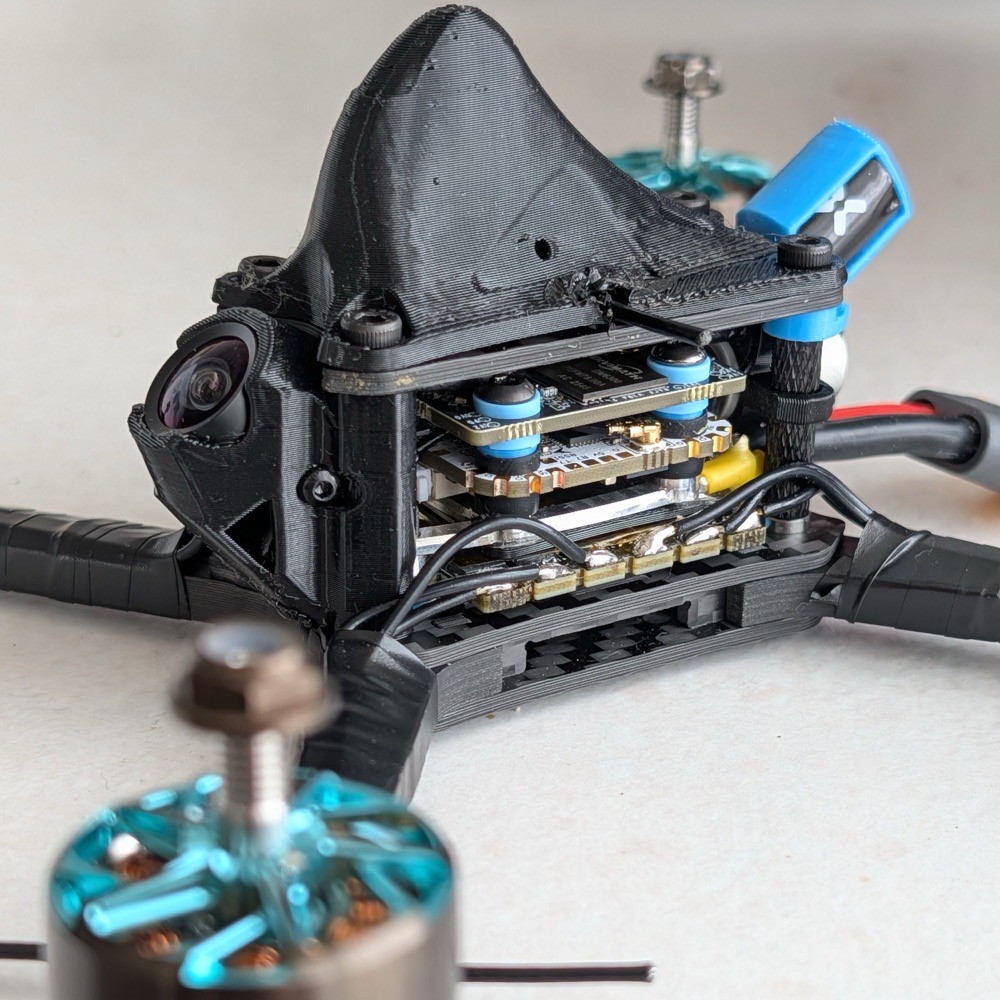
On paper, TBS promised to solve the thermal and electrical bottlenecks that plague standard 20x20mm ESCs. But after racing this hardware through rigorous heats and enduring brutal workbench post-mortems, the story took a fiery turn: every single drone I built with the complete TBS Lucid stack eventually burned down in crashes.
The ESC itself is arguably one of the finest electrical designs on the market, but its innovative "Gorilla" mounting pattern introduces a fatal mechanical vulnerability. Here is the unvarnished reality of the TBS Lucid stack, why it fails under hard racing impacts, and how a custom TPU isolation mod is giving the ESC a second chance on a new 5-inch test build.
The Gorilla Mount Crux: Engineering Brilliance Meets Mechanical Failure
To understand why the TBS Lucid ESC exists in its current form, you have to look at the limitations of standard 4-in-1 ESC layouts.
Why TBS Created the Gorilla Mount
On standard 20x20mm or 30.5x30.5mm ESCs, the four mounting bolts pass directly through holes drilled into the corners or interior of the circuit board. These bolt holes consume valuable PCB real estate, force circuit traces to squeeze through narrow copper bottlenecks, and create hot spots around the mounting standoffs.
TBS set out to eliminate this compromise by introducing their proprietary Gorilla mount (a 39.5 x 16.0mm footprint). By moving the mounting points outward to two perimeter tabs, TBS achieved several major engineering feats:
- Zero Center Holes: The PCB is an unbroken rectangle of thick copper.
- Symmetrical Current Distribution: Power flows evenly from the battery pads to all four motor outputs without asymmetric trace choking.
- Full-Size Discrete FETs: Instead of cramming undersized MOSFETs into tight corners, TBS fitted robust QN3109 full-size FETs down both flanks of the board.
The Fatal Crash Vulnerability: The Thin Middle Brace
Because the ESC PCB has zero mounting holes, the entire Gorilla mounting concept relies on an aluminum brace assembly to clamp and hold the board in place. TBS designed this around a 39.5 x 16.0mm footprint, and also sells stamped aluminum adapter brackets for standard 20x20mm and 30.5x30.5mm frames ($3.95).
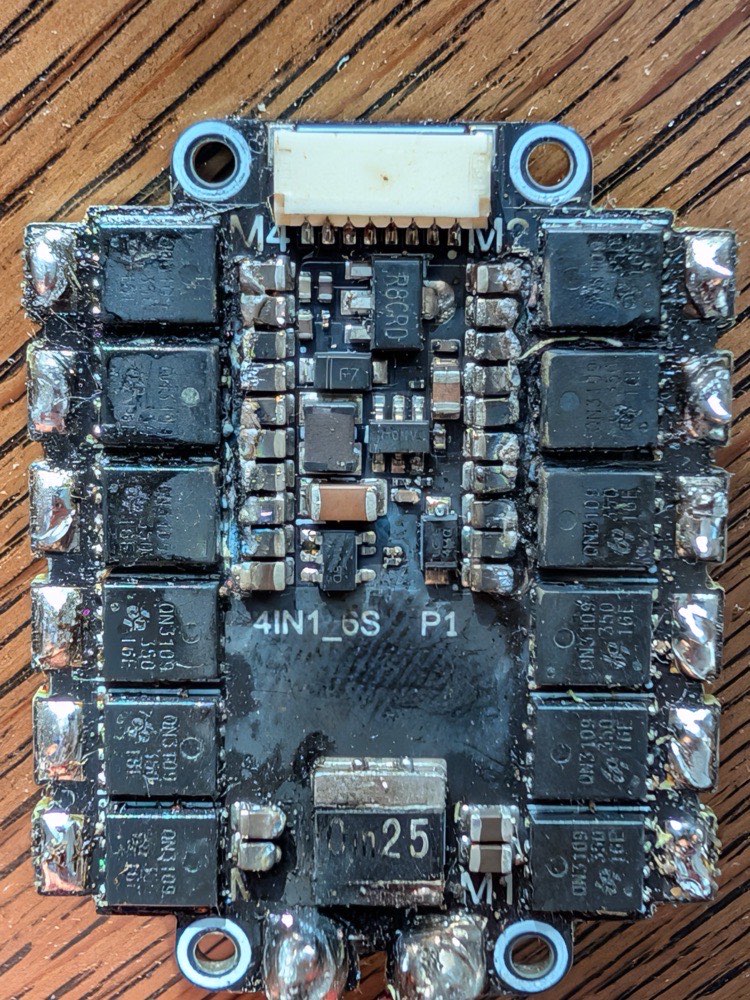
Crucially, the issue is not merely an adapter problem. Even on frames designed natively to support the Gorilla mount pattern, the ESC suffers the exact same catastrophic failures. Why? Because the system inherently relies on a thin aluminum middle brace that bridges straight across the center of the ESC board, hovering mere fractions of a millimeter above a densely populated corridor of delicate logic chips, gate drivers, and passive components.
During heavy track crashes - such as clipping a steel race gate or tumbling at high speed - this thin aluminum middle brace readily bends and flexes inward under mechanical shock. When that metal brace deflects into the center components under impact, it instantly creates a dead short between the logic rails and raw 6S battery voltage. As seen in the autopsy photo above, the result is instantaneous and catastrophic: melted copper, vaporized silicon, and a burned-out board.
The Gorilla Mount Insulation Mod Fix: To keep this phenomenal ESC flying without instant fireballs, I have engineered a custom 3D-printed TPU insulation barrier designed to physically isolate the aluminum middle brace from the ESC's central component rail. After rigorous crash testing, I am comfortable saying this simple mod dramatically increases durability and prevents shorts.
TBS Lucid Flight Controller: Solid Specs, Practical Caveats
The top half of the stack is the TBS Lucid FC, a 20x20mm board packed with modern silicon.
1. AT32 Processing Power & Gyro Selection
The flight controller runs an Artery AT32F435RMT7 microcontroller clocked at a blistering 288MHz, paired with 8MB of onboard blackbox flash and 6 hardware UARTs.
TBS offers two variants of the FC:
- Freestyle Variant: Equipped with the ICM-42688P gyro ($89.95 full stack).
- Pro Variant: Equipped with the classic MPU6000 gyro at a premium price.
Racer Benchmark Tip: The ICM-42688P gyro is completely fine. Do not waste extra money on the MPU6000 version. With modern Betaflight 4.4+ dynamic filtering and bidirectional DShot RPM filtering, the ICM-42688P tracks flawlessly without noise contamination. Save your cash for replacement props and race entry fees.
2. Layout & Receiver Bay
TBS thoughtfully included a recessed bay on the FC specifically shaped to hold a TBS Crossfire Nano, Tracer, or compact ExpressLRS receiver. This allows for an exceptionally tidy installation. The FC also includes built-in camera control and a dedicated VTX power switch (pit switch), which is a huge convenience in crowded race pits when changing settings without broadcasting over active heats.
(Note for builders: Early production batches of the Lucid FC had the UART3 RX and TX silkscreen labels accidentally swapped. TBS has corrected this on current production units, but verify your pinout against the official manual if your receiver fails to talk on UART3).
TBS Lucid 60A AM32 ESC: A Pure Powerhouse
Stripped of its mechanical mounting Achilles' heel, the TBS Lucid 60A 4-in-1 ESC is a triumph of electrical engineering.
1. Electrical Architecture & AM32 Firmware
- Continuous Current: 60A continuous (rated for 300 seconds) and 70A burst (60 seconds) on 3S–6S LiPo power.
- AM32 Native: Flashed out of the box with AlkaMotors32 (target
tbslu6s4in1), offering smooth motor commutation, variable PWM frequency, and snappy throttle response. - Unbrick Recovery Pads: TBS intelligently exposed dedicated boot/programming test pads along the perimeter of the board. If an AM32 firmware flash ever fails or corrupts, you can easily recover the board on the bench without specialized micro-soldering tools.
2. Solder Pads & Bench Serviceability
Unlike many contemporary 20x20 ESCs that cram tiny, microscopic pads directly against vulnerable SMD capacitors, the Lucid ESC features massive, heavy-duty solder pads arrayed cleanly along the outer perimeter. Tinning 18–16 AWG motor wires to this thick copper PCB is satisfying and straightforward, with zero fear of bridging adjacent resistors during high-stress pit repairs.
Giving Lucid a Second Chance: The TPU Mod & Test Build
After incinerating all of my complete TBS Lucid stacks on the race track, I was unwilling to give up on what is fundamentally one of the best ESC designs on the market. But bolting another bare Lucid ESC into a race rig would just mean another guaranteed fire.
The sole reason I am giving the Lucid ESC a second chance is the TPU isolation mod. By designing a 3D-printed TPU barrier to shield the delicate center components from the aluminum middle brace, the goal is to eliminate the dead-short failure mode once and for all.
To put this mod to the test under real track conditions, I assembled a new 5-inch test quad. For the flight controller, I chose the HDZero Halo FC - not as a fix for the ESC, but simply because it makes for an exceptionally clean, hassle-free test rig:
- Integrated UART ExpressLRS: The Halo FC integrates an onboard UART-based ExpressLRS receiver. Eliminating external receiver wiring and plugs keeps the electronics bay tidy and straightforward to inspect.
- Direct Pinout Compatibility: The multi-pin wiring harness between the HDZero Halo FC and the TBS Lucid ESC matches cleanly, requiring zero re-pinning or cumbersome wire transposition.
- Clean Form Factor: A quick bench check on the scale puts the build at 248g (without battery and props). The low stack profile fits effortlessly beneath a compact, aerodynamic 3D-printed racing canopy while leaving ample breathing room around the video transmitter.
Technical Specifications Breakdown
| Specification | TBS Lucid FC (Freestyle) | TBS Lucid 60A ESC |
|---|---|---|
| Microcontroller (MCU) | Artery AT32F435RMT7 @ 288MHz | AT32 Architecture |
| Firmware | Betaflight / INav | AM32 (Target: tbslu6s4in1) |
| Gyro Sensor | ICM-42688P | N/A |
| Current Rating | N/A | 60A Continuous / 70A Peak |
| Input Voltage | 3S–6S LiPo | 3S–6S LiPo |
| Blackbox Memory | 8MB Onboard Flash | N/A |
| UART Interfaces | 6 Hardware UARTs | N/A |
| BEC Output | 9V @ 2.5A, 5V @ 2.0A | None |
| Dimensions | 31mm × 29mm | 34mm × 44mm |
| Mounting Pattern | 20mm × 20mm | Native Gorilla (39.5×16mm) / 20x20 / 30.5x30.5 |
| Weight | 4.51g | 13.81g (Bare) / Approx. 19g (With Brackets) |
| Stack Price | $89.95 USD (Complete Stack) | $3.95 USD per Adapter Bracket |
Pros & Cons
Pros
- Exceptional ESC Power Delivery: Full-size QN3109 FETs and symmetrical copper layout provide cool, efficient, high-amperage current without voltage drops.
- Generous Motor Solder Pads: Wide perimeter pads make soldering heavy-gauge motor wires painless and pit-repair friendly.
- Native AM32 with Unbrick Pads: Excellent motor protocol support with exposed hardware recovery pads.
- Competitively Priced: At $89.95 for the full stack, it undercuts much of the premium 60A competition.
- ICM-42688P Performance: Outstanding gyro tracking without needing the expensive MPU6000 upgrade.
- Feature-Rich FC: Dedicated receiver bay, VTX pit switch, camera control, and plentiful UARTs.
Cons
- Dangerous Gorilla Middle Brace Failure Mode: The thin aluminum middle brace - whether mounted to native Gorilla frames or adapted to 20x20/30.5x30.5 - readily flexes under crash shock and dead-shorts center components.
- Proprietary ESC Footprint: Requires adapter brackets on standard 20x20 or 30.5x30.5 frames, adding mechanical complexity.
- Burnout Severity: Once the aluminum middle brace touches the logic corridor, the ESC suffers catastrophic PCB destruction and cannot be saved.
- Silkscreen Flub: Early production units shipped with inverted UART3 RX/TX markings.
Where to Buy
- Direct from Team BlackSheep: If you can wait for international shipping from TBS directly, order from their web store to ensure you receive the latest production batch with corrected silkscreen markings.
- Local FPV Resellers: If you need replacement hardware in a rush before an upcoming race weekend, grab it from trusted domestic retailers carrying TBS stock. Be sure to order spare 20x20 or 30.5x30.5 Gorilla mounting brackets ($3.95) along with your stack.
Final Verdict
The TBS Lucid Freestyle Stack is a tantalizing package. Electrically, TBS knocked it out of the park: the AT32 FC is fast and well-featured, the ICM gyro is rock-solid, and the 60A AM32 ESC is easily one of the most powerful and thermally capable boards in its class.
However, you cannot race this ESC in its stock configuration without accepting severe risk of fire in hard crashes - even on native Gorilla mount frames. Because the thin aluminum middle brace sits directly over sensitive components without structural backing or insulation, impacts routinely bend the metal into the silicon.
With the custom TPU isolation mod installed to shield that middle brace, the TBS Lucid ESC is finally getting the crash-testing redemption it deserves on my new test quad. But if you are planning to run this ESC completely stock right out of the box, proceed with extreme caution.